
“The Judgment of Paris”
In 1976, nobody in the wine world was losing much sleep over California.
Napa Valley was still the territory of a handful of stubborn dreamers, and French wine wasn’t merely considered better, French wine was wine, there simply was no other.
California was an interesting little venture happening somewhere across the Atlantic, that no-one in wine was taking the slightest notice of.
Which is why what happened in a Paris hotel room in May of that year was so remarkable.
Steven Spurrier was a British wine merchant living in Paris. He had the idea of holding a tasting to celebrate America’s Bicentennial, as a way of introducing Californian wine to his European customers.
The idea was simple.
Take some of California’s best wines and put them up against some of France’s finest.
It wasn’t intended to change the world.
It was really just a good excuse for a tasting.
So Spurrier gathered together a selection of California Chardonnays and Cabernets and arranged a panel of nine French judges.
And these weren’t casual wine drinkers.
They were some of the most respected palates in France.
People who had spent their careers knowing good wine.
And knowing where good wine came from.
To make the tasting fair, Spurrier did something very simple.
He put every bottle into a blind tasting.
No labels.
No famous names.
No clues about price or provenance.
Just wine in a glass.
The judges tasted, swirled, sniffed and scored.
And they had opinions.
They were quite confident about which wines were French and which were Californian.
Some of those assumptions turned out to be spectacularly wrong.
When the scores were finally added up, something rather awkward had happened.
A California Chardonnay had beaten the great white Burgundies.
And in the red wine tasting, a California Cabernet had beaten two French icons – Château Mouton-Rothschild and Château Haut-Brion.
California had won.
In the wine world this was like a nuclear bomb being detonated. The judges were outraged, One even tried to take her score sheet back
And this wasn’t simply a case of the judges discovering that California made decent wine.
They had discovered something much more uncomfortable.
The wines they had assumed they would prefer…
Weren’t the wines they actually preferred.
That’s the first thing I find fascinating about the story.
We all carry around ideas about what we like.
I like red wine.
I don’t like sweet things.
I’m a Chardonnay person.
I don’t like floral fragrances.
I prefer fresh and clean scents.
We build these little descriptions of ourselves over time.
And most of the time they’re useful.
But occasionally we discover that our preferences aren’t quite as fixed as we thought.
Give us something without the label…
Without the expectation…
And our taste can surprise us.
But there was another assumption being challenged in that Paris hotel room.
And I think this one is even more interesting.
The French wines weren’t simply wines the judges expected to prefer.
They were wines they expected to be better.
They had reputation.
History.
Prestige.
Generations of winemaking behind them.
Some of the names on those bottles were practically institutions.
The California wines had none of that.
They were the upstarts.
The newcomers.
And the idea that one of them might actually be better than one of the great French wines was, to put it mildly, uncomfortable.
Take away the labels, though…
And suddenly the judges had to separate two things that we often confuse.
What do I like?
And…
What is good?
They’re not necessarily the same thing.
You can recognise that something is beautifully made and still not like it.
And you can absolutely love something without it being considered the finest example of its kind.
Taste is personal.
Quality is something different.
The problem is that the two often get mixed together.
I think fragrance has exactly the same problem.
We’re surrounded by signals telling us what a fragrance is supposed to be worth before we’ve even smelled it.
The name on the bottle.
The fashion house.
The advertising.
The packaging.
The celebrity.
The price.
The reputation.
And none of those things are necessarily bad.
But they influence what we expect.
And expectation is remarkably powerful.
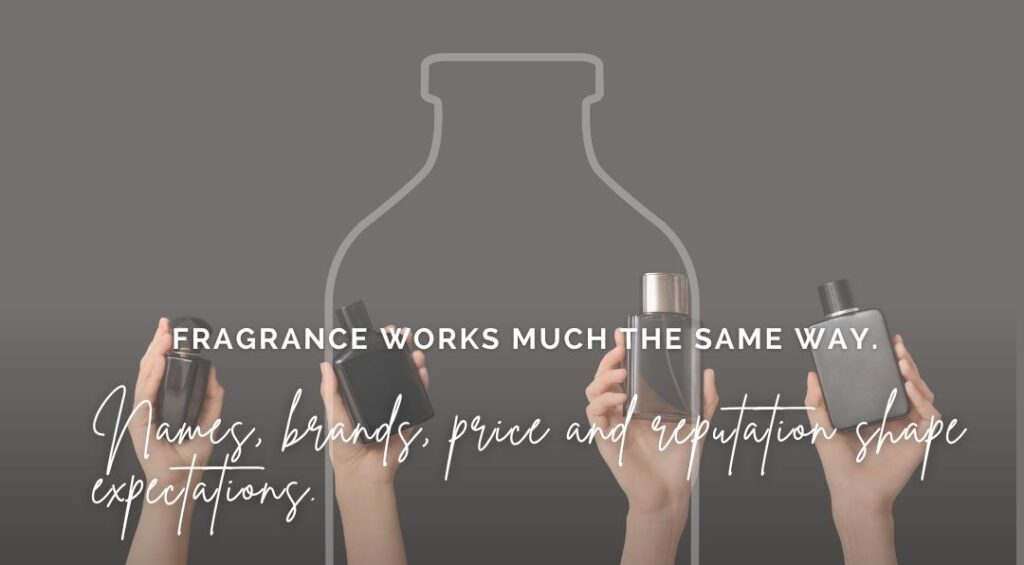
That’s one of the reasons I find inspired fragrances so interesting.
People sometimes assume that if a fragrance isn’t from the original designer house, it can’t possibly be very good.
The assumption is made before the fragrance has even been properly experienced.
But what happens when you take away the label?
When you simply smell the fragrance and ask:
Do I like this?
And then perhaps ask the second question:
Is this actually well made?
You might be surprised by the answers.
I’m not suggesting that every inspired fragrance is equal to its original.
That would be far too simplistic.
Nor am I suggesting that everyone will suddenly prefer them.
Taste doesn’t work that way.
What I am suggesting is something much simpler.
Don’t let the label make the decision for you.
Smell it.
Experience it.
Make up your own mind.

That’s one of the things I love about what we do at The Perfumery.
You don’t have to know exactly what you’re looking for.
You don’t have to know whether something is “your kind of fragrance.”
And you don’t have to decide whether something is worth trying based on the name on the bottle.
You can simply explore.
Try something familiar.
Try something completely unexpected.
And decide for yourself.
Because sometimes the most interesting discovery isn’t finding something you already knew you liked.
It’s discovering that you like something you never thought you would.
And sometimes…
It’s discovering that something doesn’t need a famous name to be very, very good.

If You’re Curious to Explore
Our Collections are designed for exactly this.
Five fragrances.
No commitment to a full bottle.
Just an opportunity to smell, compare, discover and decide for yourself.
Because you don’t have to know what you like before you start exploring.
You can start with curiosity.
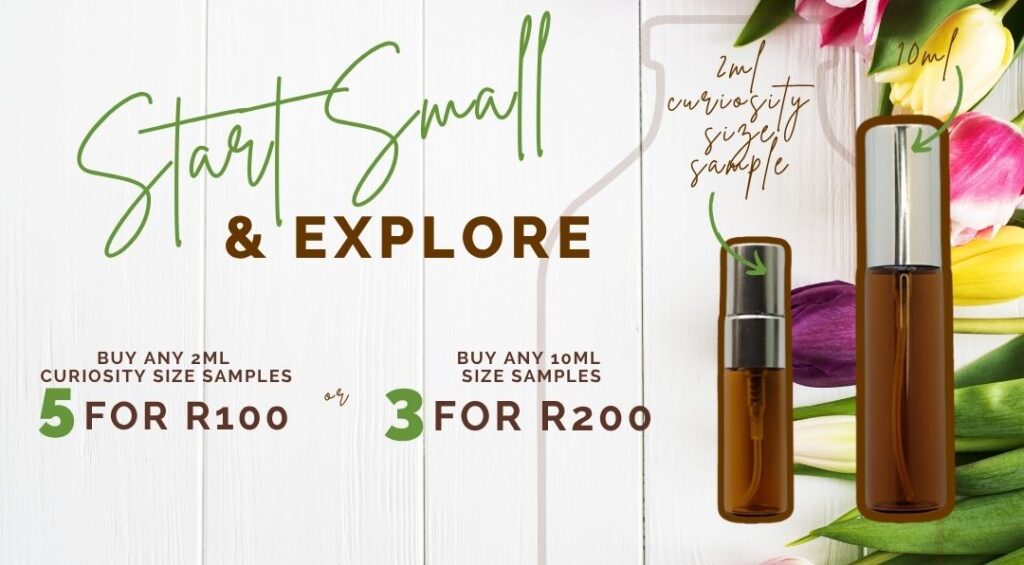
This week you can explore with:
- 5 × 2ml samples for R100
- 3 × 10ml fragrances for R200
Or, if you’ve already discovered a few favourites:
- Any 3 × 50ml fragrances for R675 to begin building a wardrobe you’ll enjoy reaching for.
Perhaps the lesson of the Judgment of Paris isn’t that California beat France.
Perhaps it’s that sometimes…
you need to take the label away before you can discover what you really think.
And maybe that’s true of fragrance too.
After all…
It’s what’s inside that counts.
Until next time
Rob
"Perfume is a form of writing, an ink, a choice made in the first person, the dot on the I, a weapon, a courteous gesture, part of the instant, a consequence."
Serge Lutens