
When He Started, He Had No Idea If He Could Finish
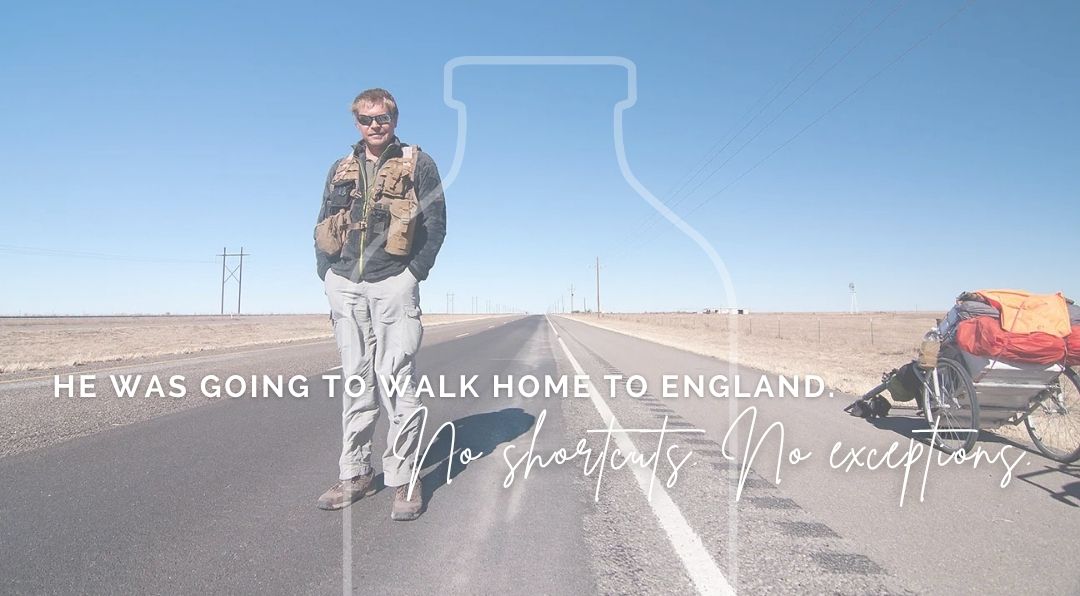
On November 1, 1998, a twenty-nine-year-old former British paratrooper named Karl Bushby stood at the southern tip of Chile with five hundred dollars in his pocket and an idea that sounded unreasonable to everyone who heard it.
He was going to walk home to England.
Not fly.
Not drive.
Not sail.
Walk.
Every step.
No shortcuts.
No exceptions.
The distance was roughly fifty-eight thousand kilometers across four continents.
His estimate was eight to twelve years.
More than two decades later, he is still walking.
And he is finally getting close.
From the beginning, Bushby set two rules.
The first was simple.
No motorised transport could ever advance the journey.
If he had to fly because of visas or borders, he would return to the exact point where he stopped and continue on foot.
The second rule was even simpler.
He could not go home until he could walk there.
Those rules turned a long walk into a life.
He crossed South America step by step.
Then came the Darién Gap — a stretch of jungle between Colombia and Panama with no roads, no infrastructure, and no easy way through.
It took him two months.
Mud. Rivers. Insects. Fear.
He came out the other side.
Still walking.
Central America followed. Then Mexico. Then the entire United States.
By 2005, he reached Alaska.
Ahead of him was the Bering Strait.
In March 2006, he stepped onto the Arctic ice.
For fourteen days, he moved across shifting ice floes, jumping gaps of open water, carrying a rifle for polar bears, wearing an immersion suit in case the ice gave way beneath him.
He reached Russia.
And was immediately arrested.
That was the beginning of a different kind of challenge.
Visas.
Bans.
Bureaucracy.
Years where he couldn’t move forward.
In 2008, the financial crisis wiped out his sponsors.
In 2013, Russia banned him entirely for five years.
At one point, with no way forward, he walked from Los Angeles to Washington, D.C., simply to stand outside an embassy and ask to continue.
Then the world shut down.
Borders closed.
Again, he waited.
When he reached the Caspian Sea with no land route forward, he made another decision that sounded unreasonable.
He would swim.
Nearly three hundred kilometers.
He trained for a year.
Thirty-one days in the water.
Cold. Wind. Endless horizon.
And then…
He kept walking.
Twenty-seven years have passed.
More than forty-seven thousand kilometers on foot.
Across four continents.
Through countries, deserts, cities, ice, and sea.
Somewhere in Europe right now, he is still walking west.
Behind him is an unbroken line of footsteps stretching all the way back to Chile.
Ahead of him are the final 1000 kilometers to home.
Why do it?
His answer is simple.
It was a challenge.
No charity. No fame.
It existed because it was hard.
And because no one had done it.
But somewhere along the way, something else happened.
Nearly everyone he met helped him.
Gave him food.
Offered shelter.
Pointed him forward.
“The world,” he says, “is a much kinder place than it often seems.”
I keep coming back to one line.
Those rules turned a long walk into a life.
He started something he had no real way of measuring.
No certainty of finishing.
No clear timeline.
Just a direction.
And a decision to continue.
Most of us don’t take on something that extreme.
But in quieter ways…
We’re all doing something similar.
We start things without knowing where they lead.
We make choices without being completely sure.
We adjust.
We pause.
We carry on.
There isn’t always a clear answer at the beginning.
Sometimes there isn’t even one at the end.
And maybe that’s the point.
It’s not about knowing exactly where you’ll arrive.
It’s about being willing to take the next step.
To keep going.
To stay open to what you discover along the way.
Somewhere in that process, things start to take shape.
Not all at once.
But gradually.
Almost without you noticing.
And one day you look back…
And realise you’ve come so much further than you ever thought you would.
He is almost home.
Until next time
Rob
"Scent is our most primitive sense, it's the closest thing to the emotional brain."
Isabelle Ramsay-Brackstone